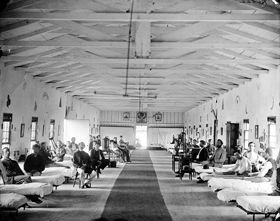
Civil War Hospital
A bill is under consideration by the Confederate Congress to incorporate Confederate hospitals–now a loose amalgamation of medical facilities variously operated by public, private or local government entities–underneath the umbrella of the national government.
Today from Richmond, a news correspondent of the Memphis Daily Appeal offers his observations of the current efficiency of the hospitals within the Confederate capital, singling out the Baptist Institute Hospital (also known as Officers’ Hospital, Institute Hospital, and Richmond General Hospital #4) for his highest praise.
… [the] bill for placing the Confederate hospitals under military organization can have no other effect than to diminish greatly the comfort of our sick and wounded soldiers, and give to several hundred officers, who are wanted in the field, safe and snug places where they can do not nothing [sic] efficiently. There are no nurses like the women. The hospitals of Richmond are many of them models of comfort and cleanliness, and their good management is due to the untiring energy and administrative capacity of the noble women of our city, ladies of gentle birth and high culture who are proud to give their time to the holy work, and who ask no earthly remuneration, whose reward will be on high. A writer in the Whig, Colonel P. W. Alexander, well known as the correspondent of the Savannah Republican, testifies to the admirable routine of the hospital kept in the Baptist Institute building under the matronly superintendence of Mrs. Lewis N. Webb, of Richmond. Col. Alexander speaks from personal experience in the matter, having been himself an inmate of this establishment during his recent illness. It is to be hoped that his letter will have some effect upon the minds of Congress. . . .
The hospital bill fails and thus does not become law.
Following the war, Mrs. Lewis N. Webb becomes a leader in the Confederate memorial movement.
Source: Memphis Daily Appeal, March 11, 1863 (the article being written on March 2) (link); more information about Baptist Institute Hospital (link); see Mrs. A. W. Garber, “Confederate Memorial Literary Society,” 1896 (link)


